Core technical principles of room-temperature, ambient-pressure superconductors.jpg

To develop a room-temperature, ambient-pressure superconductor, one must understand why electrical resistance disappears in a superconductor.
When the temperature is lowered to absolute zero (-273 degrees), the movement of positive charges stops.
At this point, if electrons are allowed to flow, the positive charges do not react to the electric field during the electron flow process.
This is why electrical resistance becomes zero.
However, when the temperature rises, the flowing electrons pull on the positive charges, and the energy used for that pull creates electrical resistance,
causing energy to decrease and heat to be generated.
Therefore, to create a room-temperature, ambient-pressure superconductor in a new form, we use a positive charge electric field vacuum transmission line.
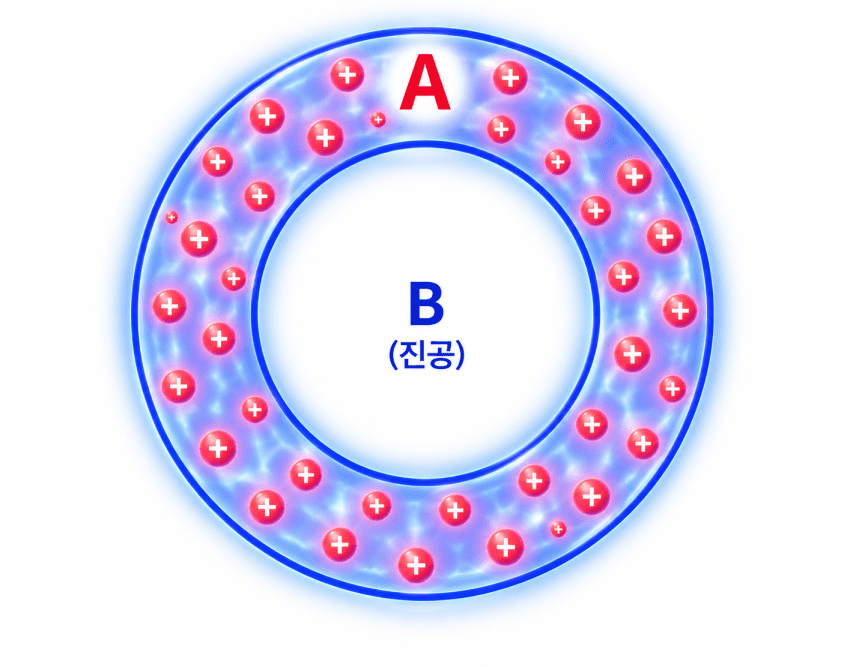
Space B is in a vacuum state and is surrounded by a blue insulator.
Space A is filled with positive charge material,
and there is an electric field created by these positive charges.
By charging electrons into space B, the electrons are bound to the electric field.
Then, the positive charges in A are completely fixed. This can be done by lowering the temperature,
or by increasing the concentration and density of the positive charges so that their movement is controlled by the electron electric field.
In this way, the positive charges are completely fixed by the pressure caused by their own electrical repulsion at room temperature and ambient pressure.
Ultimately, once the positive charges are completely fixed, electrons are charged into the electric field created by the positive charges, and then moved by pushing those electrons.
To achieve this, the insulator in the direction of the positive charges should be made with a porous structure to induce the bonding of the positive charge material,
which allows for more effective and stable movement fixation.
In conclusion, perfectly fixing the positive charges is the core technical principle for developing room-temperature, ambient-pressure superconductors.
Comments 0