Han Dong-hoon's Loach Technique
No translation in your language yet — showing the English version
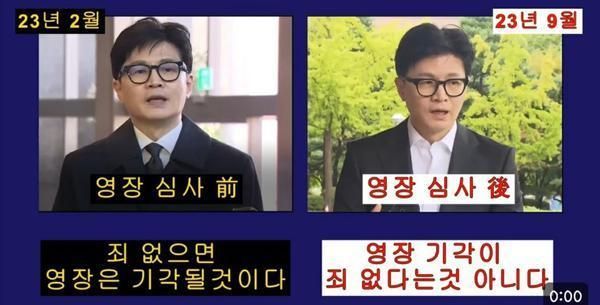
The method used by former People Power Party leader (and former Minister of Justice) Han Dong-hoon to answer questions with questions is referred to in the media and political circles as the so-called "counter-questioning speech" or "question-answering-with-questions." [1, 2]
This speech style is primarily used to exploit logical loopholes or to seize control of the conversation, and it can be broadly divided into four patterns.
- Shifting the topic to the opponent (the so-called "What about Lee Jae-myung?" pattern)
When receiving a question disadvantageous to himself or his political party, he responds by bringing up similar cases involving the opposing camp or other subjects. [1]
Characteristics. It shifts the focus of the question from himself to the opponent's fairness or issues of hypocrisy (double standards).
Actual Case. When criticized regarding the People Power Party's candidate verification or the replacement rate of sitting lawmakers, instead of answering directly, he deflected the question by asking, *"Please apply that same evaluation to the Democratic Party. (Don't you refrain from raising such issues with the Democratic Party?)"* or *"Is what Representative Lee Jae-myung doing considered reform?"* [1]
- Questioning premises and definitions
This method involves challenging the premises or the meaning of words used by the questioner to question the very validity of the question itself. [1]
Characteristics. Similar to interrogation techniques used during his time as a prosecutor, he demands precise evidence and definitions for every single word, effectively silencing the opponent.
Actual Case. During government interpellation sessions, if an opposition lawmaker criticizes a specific issue, he might counter with, *"Assemblyman, what kind of law are you intending to create?"* or demand specific evidence by implying the premise of the question is wrong, such as, *"Did I ever say such a thing?"* This characteristic was also depicted in the satirical webtoon about Han Dong-hoon going to a convenience store that became a hot topic online https://www.kmib.co.kr/article/20230406500288, where he responds to the clerk's words with, *"How do you know I am trying to buy something?"* and *"How do you define business obstruction?"* [1, 2, 3, 4, 5]
- Demanding empathy through hypothetical scenarios
When faced with an aggressive question, he shifts the burden of choice or judgment to the questioner by suggesting they consider the situation from a different perspective. [1]
Characteristics. This is mainly used to reconstruct a difficult-to-answer situation into a hypothetical one to persuade others that his response was inevitable.
Actual Case. During the controversy regarding the ignoring of Ms. Kim Keon-hee's text messages, in response to a reporter's question, he countered by demanding an answer from the questioner, saying, *"Let's look at it from the other side. Suppose that text message was made public; let's assume I responded in a certain way."* [1]
- Pointing out the questioner's intention or qualifications
This method involves undermining the credibility of the question by pointing out the attitude, background, or intention of the person asking, rather than addressing the content of the question itself. [1]
Characteristics. While giving the impression that he is not avoiding the question, he actually builds a defensive shield by questioning the questioner's intent.
Actual Case. A representative example is when he addressed an attendee who asked a sharp question at a press conference by verifying the person's affiliation or status, pointing out, *"Isn't it strange for an employee of the Prime Minister's Office to be asking questions at a press conference?"* [1, 2]
0
Comments 0