How Stablecoins Are Entering Trade Finance — And What It Means for Exporters
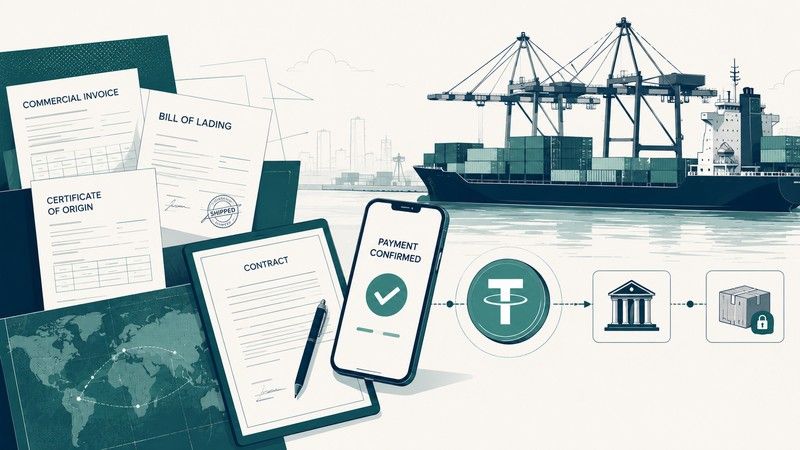
How Stablecoins Are Entering Trade Finance — And What It Means for Exporters
The problem stablecoins are solving
When an exporter in South Korea ships goods to a buyer in the UAE, the payment doesn't travel directly from the buyer's bank to the exporter's bank. It moves through a chain of correspondent banks — intermediary institutions that maintain accounts with each other and relay the transfer across jurisdictions. Each link in that chain adds time, fees, and a potential point of failure.
A standard international wire transfer takes two to five business days and costs between $25 and $50 per transaction, sometimes more depending on the currency pair and the number of intermediaries involved. For small and medium exporters moving shipments of $50,000 to $500,000, those fees are manageable but not trivial. The timing is the bigger issue: when payment is tied to documentary credit (letter of credit, or LC) terms, a two-to-five day settlement window interacts with the document presentation deadlines in ways that compress an already tight timeline.
Stablecoins don't eliminate the underlying trade — they change the payment rail. Instead of routing through correspondent banks, settlement happens on a blockchain network, peer-to-peer, in minutes rather than days, at a fraction of the cost.
What makes a stablecoin different from regular cryptocurrency
The volatility problem that makes Bitcoin or Ether impractical for trade settlement doesn't apply to stablecoins. A stablecoin is a digital token pegged to a stable reference asset — typically the US dollar — so one unit of the stablecoin equals one US dollar, maintained through reserves held by the issuing institution.
For trade finance purposes, this matters because the exporter quoting a price in USD doesn't want the payment to arrive worth 15% less because the token depreciated between shipment and settlement. A USD-pegged stablecoin eliminates that exposure while still capturing the speed and cost advantages of blockchain settlement.
RLUSD (Ripple USD, a regulated USD-pegged stablecoin issued by Ripple) is one of the stablecoins emerging specifically in the cross-border payments and trade finance context. It operates on the XRP Ledger (XRPL), a blockchain network designed for fast, low-cost financial transactions — settlement typically completes in three to five seconds, with transaction costs measured in fractions of a cent.
Three ways stablecoins are actually being used in trade
1. Direct settlement between trading partners
The simplest use case: buyer and seller agree to settle in stablecoins instead of wiring through correspondent banks. The buyer transfers stablecoins to a designated wallet address when shipment conditions are met; the exporter receives equivalent USD value within seconds. No intermediaries, no multi-day clearing window, no per-transaction correspondent fees.
This works best for established trading relationships where both parties have the infrastructure to hold and transact in digital assets — and where the regulatory environment in both jurisdictions permits it.
2. Escrow-based payment against document delivery
A more structured approach that mirrors the logic of a letter of credit: the buyer locks stablecoins in a smart contract escrow at the time of order. The escrow releases to the exporter when defined conditions are met — typically proof of shipment, confirmed document submission, or a combination of both.
This is the model that maps most directly onto existing trade finance practice. The buyer's payment commitment is visible and verifiable on-chain from the moment the escrow is funded — which provides the exporter with something closer to payment certainty than a purchase order or even a bank guarantee in some contexts.
3. Proof of funds verification
Before agreeing to produce goods or extend credit terms, exporters need to know the buyer can actually pay. In traditional trade, this involves bank reference letters, financial statements, or credit checks — a process that takes time and provides static information that may not reflect the buyer's actual current position.
On-chain proof of funds changes this: a buyer can demonstrate liquid stablecoin holdings in a verifiable, real-time way without revealing sensitive financial information beyond what's necessary. The exporter sees that funds exist and are controlled by the counterparty — not a statement from three months ago.
Settlement comparison: Correspondent banking: 2–5 business days, $25–50+ per transaction. XRPL stablecoin settlement: 3–5 seconds, fractions of a cent per transaction.
What the regulatory picture looks like right now
Stablecoin regulation varies significantly by jurisdiction, and this is the most important practical constraint for exporters considering this settlement model. Some jurisdictions — including the UAE's Abu Dhabi Global Market (ADGM) — have developed specific regulatory frameworks for digital asset businesses, including non-custodial payment infrastructure. Others are still developing their positions.
The practical implication: stablecoin trade settlement is operational and compliant today in a growing number of markets, but the exporter's legal exposure depends on which regulatory environment governs their specific transactions. This is a due diligence step, not a reason to dismiss the model.
The trajectory is clear. Central banks and financial regulators in major trading economies are moving toward formal stablecoin frameworks, not away from them. Exporters who understand the mechanics now are better positioned when those frameworks solidify.
What this means for exporters practically
Stablecoins don't replace letters of credit or eliminate the need for trade documentation — at least not in the near term. What they change is the payment layer underneath those instruments. An LC-backed transaction can still use stablecoin settlement for the actual fund transfer; the documentary credit structure governs what triggers payment, the stablecoin infrastructure governs how fast and cheaply that payment moves once triggered.
For small and medium exporters in particular, the cost and timing advantages compound over a portfolio of transactions. If you're doing 20 shipments a year with an average settlement delay of three days and $40 in correspondent fees per transaction, stablecoin settlement converts some of that friction into recovered working capital and faster receivables.
How T flow integrates stablecoin settlement
T flow is a full-stack trade operations and trade finance infrastructure platform covering B2B Marketing, RFQ, contract, documentation, LC verification, and settlement in a single system. The settlement layer is being developed on XRPL and RLUSD — in active collaboration with Ripple
Here is T flow free trial → tflowx.com
#stablecointradefinance#RLUSD#XRPLtradepayment#crossbordersettlement#trade financeblockchain#exportpayment#digitaltradefinance#stablecoinsettlement#B2Btrade payment #Tfow
Comments 0