What Is FOB? The Basics of Free On Board
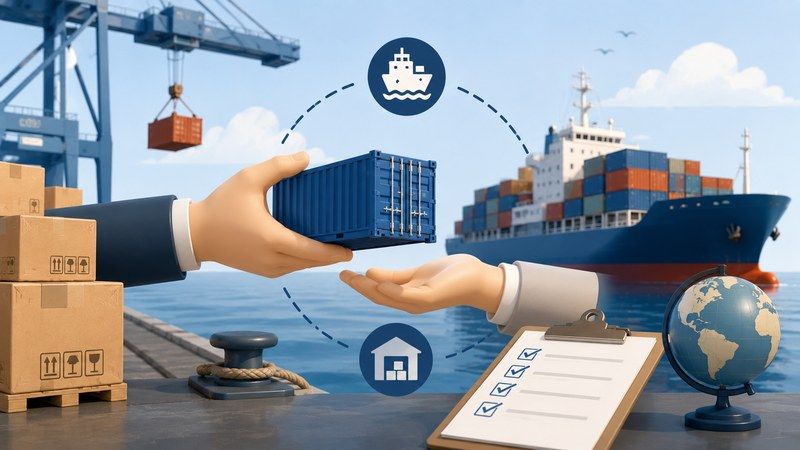
FOB is the Incoterm exporters encounter most often. Here is exactly where the seller's responsibility ends, when risk transfers, and what it means for your documents.
What FOB means
FOB stands for Free On Board. Under this term, the seller is responsible up to the point where goods are placed on board the vessel nominated by the buyer at the named port of shipment.
FOB is always stated with a named port of shipment: FOB Busan, FOB Shanghai. Note that this is the departure port, not the destination. That distinction separates it from CIF.
Risk and cost transfer at the same point
The FOB structure is straightforward. The moment goods are placed on board the vessel at the port of shipment, both risk and cost pass to the buyer at the same time.
FOB core structure
Risk transfer and cost transfer happen at the same point: on board the vessel at the port of shipment.
This is where FOB differs decisively from CIF. Under CIF, risk transfers at the port of shipment but the seller pays cost all the way to the destination port. Two separate points. FOB has only one.
Who does what
Seller (exporter)
Load goods on board at the named port
Clear for export, pay export duties
Bear all costs up to loading
Provide proof of delivery to the buyer
Buyer (importer)
Contract carriage and pay freight
Bear all risk once goods are on board
Arrange insurance (optional, not required)
Clear for import, pay import duties
Pay attention to insurance here. Under FOB the seller has no obligation to insure. The buyer arranges cover if they judge it necessary. That is another meaningful difference from CIF.
How FOB shows up in your documents
FOB is not only a contract term. It appears in your export documents, and in a letter of credit (LC) transaction, the bank examines exactly that.
The commercial invoice must state the Incoterm exactly as the credit does, including the named port of shipment. FOB Busan is correct. FOB Korea is not. Naming a country instead of a port creates a discrepancy.
The bill of lading normally reads Freight Collect, because the buyer pays freight under FOB. A Freight Prepaid notation contradicts the trade term stated on the invoice.
The insurance document is not required unless the letter of credit specifically calls for it, since the seller has no insurance obligation.
Free resource
CIF and FOB Practical Guide (PDF)
A comparison table of all eleven Incoterms, a full breakdown of FOB and CIF, and a pre-presentation checklist for letter of credit documents with the applicable UCP 600 articles cited for each item. Built to print and keep on your desk.
Download free → https://guild.tflowx.com/post/96
What to watch for with FOB
FOB requires loading onto a vessel nominated by the buyer. So what happens if the buyer delays nomination, or the vessel does not arrive on schedule? The goods sit at the port, loading cannot occur, and risk stays with the seller.
Incoterms 2020 addresses early risk transfer in this situation, but in practice a specific clause in the sales contract is safer. We cover this scenario in detail in a separate article.
One more point: FOB applies only to sea and inland waterway transport. It cannot be used for air freight. For containerized cargo handed over at a terminal, FCA is more appropriate than FOB.
#FOB Incoterms #what is FOB #Free On Board #Incoterms 2020 #FOB risk transfer #FOB bill of lading #export documentation #letter of credit Incoterms #trade terms #FOB vs CIF
Comments 0