Packing List Discrepancies: The 3 Mistakes That Get LC Payments Rejected
Trade documentation | Letter of credit (LC) | Export operations
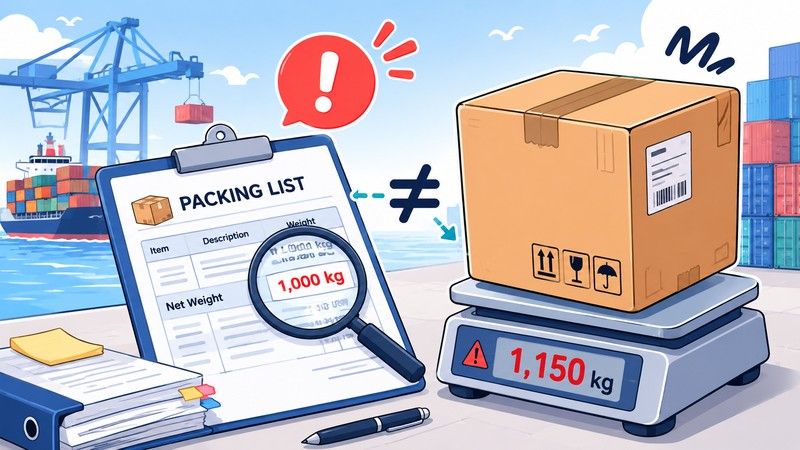
What Counts as a Packing List Discrepancy Under Letter of Credit (LC)
A packing list looks like a simple shipping form. It lists the quantity, weight, package count, and shipping marks for a shipment. Under a letter of credit (LC), it is also one of the stipulated documents a bank examines before releasing payment.
That examination follows UCP600 Article 14, the standard banks use to review presented documents. The article does not require every document to say exactly the same thing word for word. What it does require is that the data across documents must not conflict. A packing list that quotes a different package count than the bill of lading, or a weight figure that does not add up against the commercial invoice, creates exactly the kind of conflict a bank examiner is trained to catch.
For exporters who prepare packing lists quickly, often by copying numbers from a previous shipment or letting a warehouse team fill in the details, this standard is easy to miss. The packing list feels like paperwork. To the bank, it is evidence that has to line up with everything else in the document set.
The Weight Mismatch Trap: Gross vs Net Weight Errors
The most common packing list error is a weight mismatch. Two versions of this show up repeatedly.
The first is confusing gross weight (the weight of goods plus packaging) with net weight (the weight of the goods alone). A warehouse worker enters one figure in the field meant for the other, and the packing list now disagrees with the invoice or the certificate of origin, which may reference net weight separately.
The second is a totals error. Each carton has a weight entered individually, but the summed total at the bottom of the packing list does not match the total quoted on the bill of lading. This often happens when the packing list is finalized before the last carton is weighed, and nobody updates the total afterward.
Neither error is intentional. Both are the kind of small inconsistency that Article 14 treats as a conflict between documents, which is enough for a bank to raise a discrepancy.
Package Count and Marks and Numbers Inconsistencies
The second recurring problem is a mismatch in package count or shipping marks.
Package count discrepancies happen when the number of cartons, pallets, or bags on the packing list does not match what the freight forwarder recorded on the bill of lading. A last minute change, such as combining two cartons into one during loading, is rarely reflected back on the packing list before it goes into the document set.
Shipping marks and numbers, the identifying codes stenciled or labeled on each package, are just as sensitive. If the packing list shows "Carton 1 to 50" but the bill of lading shows "Carton 1 to 48" because two cartons were consolidated, that is a documented inconsistency a bank examiner will flag.
These errors are rarely caught by the person preparing the packing list because they are working from their own records, not comparing side by side against the invoice and the transport document at the same time.
Why Banks Cross Check Packing List Against Invoice and B/L
Banks do not examine a packing list in isolation. Under the Article 14 standard, an examiner is checking whether the packing list, the commercial invoice, and the bill of lading tell a consistent story about the same shipment.
This is where the "must not conflict" language matters. The packing list does not need to repeat every detail from the invoice. But if the invoice states a shipment of 500 units and the packing list totals 480 units across its cartons, that gap is a conflict, not a stylistic difference. The bank is not being difficult. It is applying the same cross document consistency check to every LC presentation it handles.
For exporters, this means the packing list cannot be finalized independently of the other documents. It has to be checked against the invoice and the bill of lading as a set, not signed off as a standalone form.
The Real Cost of a Packing List Discrepancy
Typical impact of a discrepant packing list:
Discrepancy fee: USD 75 to 300
Payment delay: 7 to 14 days
A discrepancy does not just mean a phone call from the bank. Once a discrepancy is flagged, the exporter typically has to correct and resubmit the documents, the issuing bank charges a discrepancy fee, and payment is held until the corrected set is accepted. For exporters operating on thin margins or tight cash flow schedules, a two week delay on a single shipment can ripple into the next production cycle.
How T flow L/C Checker Catches These Before You Submit
The pattern behind most packing list discrepancies is the same: a number on one document does not match the same number on another document, and nobody caught it before the documents were presented.
T flow L/C Checker is built to catch exactly this kind of cross document conflict before submission. It checks the packing list against the invoice and the bill of lading for weight, package count, and marks and numbers consistency, using the same standard a bank examiner applies. Where a discrepancy is close to a judgment call, the platform routes it to a human reviewer instead of relying on automation alone, because trade documentation still involves cases that need experienced eyes.
That combination, an automated first pass plus a human review layer, is what makes T flow a full stack trade operations and finance infrastructure rather than a simple document scanning tool. Catching a weight or count mismatch before it reaches the bank is the difference between a routine LC payment and a two week delay.
Stop packing list discrepancies before they reach the bank
T flow L/C Checker cross checks your packing list, invoice, and bill of lading automatically, with a human reviewer on standby for the edge cases.
#packing list discrepancy #letter of credit #LC document examination #UCP600 #export documentation #trade finance #T flow L/C Checker
Comments 0