The reason why the secondary battery revolution occurred.jpg

Hydrogen is the smallest atom and has an energy density 1,250 times higher than lithium ions, but
it has been known to be unsuitable as a battery material because
it has high momentum when combined with electrons.
That is why hydrogen is stored in a liquefied state at very low temperatures to create hydrogen fuel cells.
However, to form a covalent bond with one hydrogen ion, one carbon atom is required.
Because the mass of the carbon used must also increase relative to the energy density, the full potential of such a battery could not be realized.
But a solution did exist.
It is to create a battery based on the principle of storing charge in a capacitor, by separating hydrogen into hydrogen ions and electrons for storage.
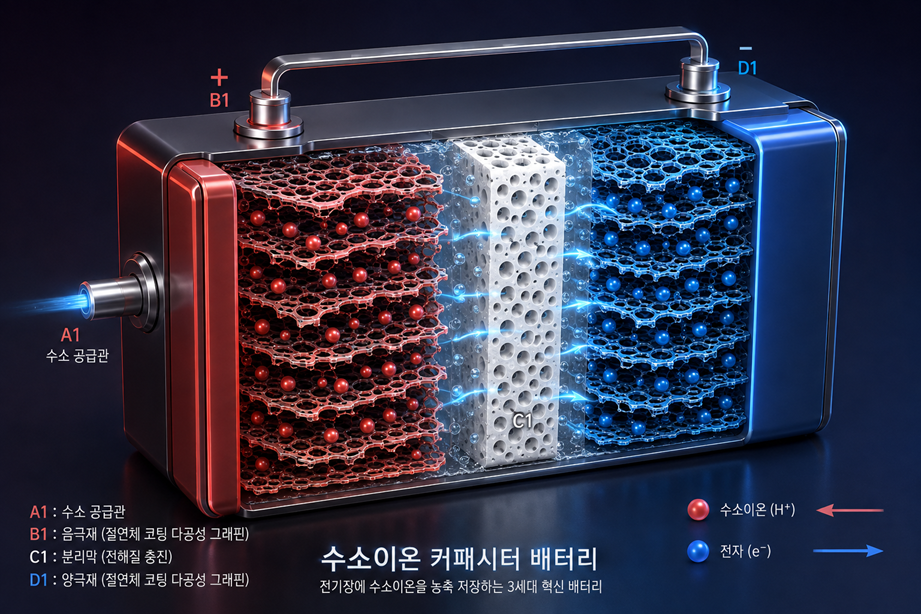
This battery is the ultimate hydrogen-ion battery,
where porous graphene is coated onto the anode as an insulator.
Then, it is filled with liquid electrolyte, and a cathode reaction electrode is installed on the cathode.
When charging begins by supplying hydrogen, the hydrogen is separated into hydrogen ions and electrons;
at this time, the electrons travel through the wire to the anode and reach the graphene,
while the hydrogen ions are pulled through the separator to the anode by an electric field.
However, since the anode part is coated with an insulator, they do not come into direct contact.
By doing this, hydrogen ions can be dramatically concentrated and stored even with a low graphene mass.
Instead of covalent bonding, the hydrogen ions are concentrated and stored within an electric field.
It has been said that an era could come where the same technology used in standard AA batteries could be used for car batteries,
and this can be described as a super-gap, hyper-innovative technology that makes it possible.
To make the anode and cathode form a covalent bond with hydrogen ions, the density and amount of graphene must increase,
which increases the weight; however, the method of separating and storing them via an electric field with an insulator allows for the concentration and storage of hydrogen ions.
When hydrogen is charged, if the pH goes from 7 to 1, the concentration of hydrogen ions increases 1,000,000 times.
If you lower it to pH -1, pH -2, pH -3, or even pH -10, the concentration increases by 10 million, 100 million, 1 billion, and up to 100,000,000,000,000 times.
The energy density of the battery is determined by the concentration of hydrogen ions trapped in the electric field.
Once charging is complete, the hydrogen supply pipe is closed, the cathode reaction electrode is separated from the cathode,
the same cathode active material is attached, and the insulator-coated graphene is combined to complete the battery.
Then, the hydrogen ions only move back and forth through the separator,
and the electrons only move through the wires to the outside of the anode and cathode.
By using the principle of a capacitor to trap hydrogen ions within a separator and an electric field,
this battery is an innovative structure that pulls 100% of the potential energy of hydrogen ions,
making it a super-gap, hyper-innovative technology.
If batteries that use direct covalent bonding with graphene were the 1st generation, this battery—which uses the principle of a capacitor to concentrate and store hydrogen ions—is a new type of battery that would typically only be developed after at least three generations of progress.
This battery is what starts the revolution in secondary batteries.
Comments 0