7 Common Letter of Credit Discrepancies (With Real Examples)
7 Common Letter of Credit Discrepancies (With Real Examples)
Introduction
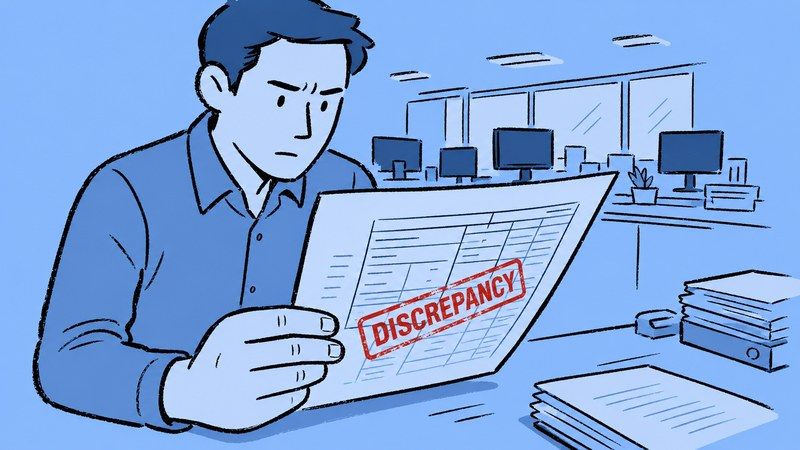
You submit your export documents, expect payment within days, and then the bank comes back with one word that stops everything: discrepancy. If you've experienced this, you're not alone — a large share of letter of credit (LC, a bank-issued payment guarantee used in international trade) document sets get rejected on first presentation, not because the underlying trade was risky, but because of small mismatches between the documents and the LC terms.
This article walks through the seven discrepancy types that show up most often, with concrete examples of what they look like in practice, so you can catch them before your bank — or your buyer's bank — does.
What is a letter of credit discrepancy?
A discrepancy is any difference between what the letter of credit requires and what the submitted documents actually show. Banks examine documents strictly under UCP 600 (Uniform Customs and Practice for Documentary Credits, the global rulebook banks follow when checking LC documents) and ISBP 745 (International Standard Banking Practice, the detailed companion guide for how those rules are applied in practice). Even a single typo or a date one day off can trigger a rejection.
1. Inconsistent data across documents
Example: The invoice lists the buyer's address as "123 Trade St., Suite 4B" while the packing list shows "123 Trade Street, Unit 4B." To a human reader, these are obviously the same address — to a document examiner working under strict compliance rules, they don't match.
This is the single most common discrepancy category. Every document in the set — invoice, packing list, bill of lading, certificate of origin — must describe the same goods, parties, and figures in a mutually consistent way.
2. Late shipment or late presentation
Example: The LC requires shipment by June 15 and document presentation within 21 days after shipment. The goods ship on June 18 (already late) and the documents reach the bank on day 23 (also late).
These are two separate failure points that often get confused. Shipment date comes from the transport document; presentation deadline is calculated from there. Missing either one independently invalidates the documents.
3. Description of goods doesn't match the LC
Example: The LC specifies "Grade A frozen shrimp, headless, 16/20 count" but the invoice simply states "frozen shrimp." Under UCP 600, the goods description in the invoice must correspond with the description in the credit — it doesn't need to be word-for-word everywhere, but commercial invoices are held to a stricter standard than other documents.
4. Missing or incorrect endorsements
Example: A bill of lading made out "to order" requires endorsement by the shipper to be negotiable, but the copy submitted is unendorsed.
This is a frequent and entirely avoidable discrepancy. Whether a document needs to be endorsed — and by whom — depends on how it's consigned, and it's one of the first things document examiners check.
5. Insurance document gaps
Example: The LC requires coverage of 110% of the invoice value under "All Risks" terms, but the insurance certificate only shows 100% coverage, or the wrong Incoterm-driven coverage start point.
Insurance discrepancies cluster around two things: the percentage of coverage and the date the coverage becomes effective relative to the shipment.
6. Wrong or missing certificates
Example: The LC calls for a certificate of origin issued by a Chamber of Commerce, but the exporter submits a self-certified origin statement instead.
Certificates — origin, inspection, fumigation, health — are often the most overlooked category because they're prepared by third parties on tight timelines, leaving little room to catch errors before the deadline.
7. Bill of lading clausing issues
Example: The carrier notes "packaging slightly damaged" on the bill of lading. This makes it a "claused" or "dirty" bill of lading, which most LCs explicitly reject unless they state otherwise.
Banks generally require a "clean" transport document — one without any clause expressly declaring a defective condition of the goods or packaging.
The real cost of a discrepancy
Typical cost of a single discrepancy: $75–300 in bank fees, plus 7–14 days of payment delay while documents are corrected and re-presented — and in some cases, the buyer gains negotiating leverage to request a price reduction in exchange for waiving the discrepancy.
How T flow L/C Checker helps
T FLOW isn't just a document checker — it's a full-stack trade operations and trade finance infrastructure platform covering the entire flow from storefront and RFQ through contracts, documents, shipping, and settlement. Within that platform, T flow L/C Checker applies AI grounded in UCP 600 and ISBP 745 to review your document set against the LC terms before you present them to the bank, flagging the kind of mismatches covered above while there's still time to fix them.
Catch these discrepancies before your bank does.
[Try T flow L/C Checker →] https://guild.tflowx.com/lc
#letter of credit #LC discrepancy #trade finance #UCP600 #ISBP745 #export documentation #documentary credit #bill of lading #trade compliance #international trade #B2B export #document examination
Comments 0