Your Bank Rejected Your Letter of Credit Documents. Here's Exactly Why — and a Free Checklist to Make Sure It Never Happens Again
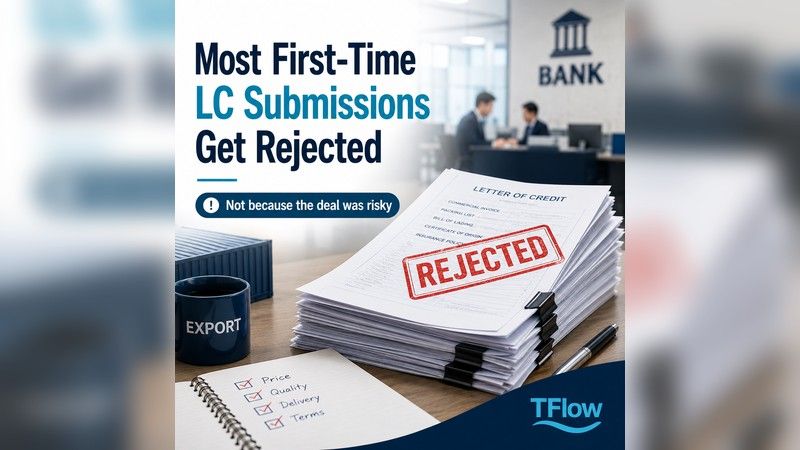
Your Bank Rejected Your LC Documents.
Here's Exactly Why — and a Free Checklist to Make Sure It Never Happens Again
Your payment is sitting in limbo. The bank sent back your documents with something called a "discrepancy notice." You're not sure what went wrong, and your buyer is already asking questions.
This happens to around 60% of exporters on their first LC submission — and to plenty of experienced ones too. The good news: almost every rejection is caused by a small, fixable paperwork mistake. Not fraud. Not a problem with the goods. A wrong currency symbol. A missing word in a signature block. An insurance date that's off by one day.
What a rejection actually costs you
Bank fees: $75–$300 per discrepancy item. Payment delay: 7–14 days, sometimes longer. On a $100,000 shipment that's already on a ship, waiting two more weeks to get paid is a real problem — especially when you have suppliers to pay. The fix takes about 30 minutes with the checklist at the bottom of this page. The mistake takes 3 seconds to make.
This article explains what banks are actually checking, in plain terms. A letter of credit works under an international rulebook called UCP 600 (Uniform Customs and Practice for Documentary Credits) — but you don't need to read 39 articles. We've already done that. The checklist at the end covers all six document categories your bank will review.
🏦
Every step in the LC chain is a potential rejection point — most happen at document preparation.
A. Your Invoice — Where Most Rejections Start
The invoice is the document you know best — you've been making them for years. Which is exactly why it's the most common source of rejection. Small habits that work fine for regular sales orders trip up when a bank examiner reads them against an LC (letter of credit) word by word.
Here's what the bank is actually checking (the official rules live in UCP 600 Article 18, but we'll keep it plain):
First, the bank has to be able to tell the invoice came from you
Your invoice must show that it came from you — the exporter (called the "beneficiary" in LC terms). This doesn't have to be fancy letterhead. A signature stamp works — but the stamp has to include your company name in the same language the LC requires.
Common mistake
Korean exporters often stamp invoices with a Korean-language company seal when the LC requires all documents in English. The bank can't match the Korean stamp to the English company name in the LC — so it's rejected. The fix is a stamp that clearly shows your English company name. (ICC Opinion R907)
The goods description trap
The bank compares your invoice description against the LC word by word. You're allowed to add extra details — but only if they don't change what the goods fundamentally are. Think of it this way: the bank is reading category labels, not reading your mind.
What the LC saysWhat the invoice saysResult
| HYDRAULIC DRILLING RIG ABI 12/14300 | HYDRAULIC DRILLING RIG ABI 12/14300 WITH SPARE PARTS | ✓ OK — same goods, added detail |
| HYDRAULIC DRILLING RIG ABI 12/14300 | SECOND HAND HYDRAULIC DRILLING RIG ABI 12/14300 | ✗ Rejected — "second hand" changes the category |
| KOREAN KIMCHI AND FOODSTUFFS | KOREAN KIMCHI AND FOODSTUFFS + free sample (chonggak kimchi) | ✗ Rejected — unlisted goods, even free ones |
| USD 200,000 | $200,000 (written by a Korean exporter) | ✗ Rejected — "$" is ambiguous outside the US |
That last one surprises people. The "$" symbol could mean US dollars, Canadian dollars, Australian dollars, Hong Kong dollars — banks outside the US treat it as ambiguous. Always write "USD" explicitly. (ISBP 745, C7)
B. Your Shipping Document (B/L) — Three Things That Trip People Up Every Time
The bill of lading (B/L) is the document that proves your cargo is on a ship. Banks treat it as collateral — they won't release payment until they're satisfied the goods are actually moving. So they read it very carefully.
1. The signature block has to pass a three-part test
When a freight agent signs the B/L on behalf of the shipping company, the signature block needs to show three things: who is signing, their role (agent), and who they're acting for. Missing any one of these causes rejection.
Correct format
"ABC Shipping as Agent for XYZ Shipping, the Carrier"
Signer name ✓ + capacity ("as Agent") ✓ + carrier name ✓
The word "by" also works: "By ABC Shipping as Agents for XYZ Shipping, the Carrier" (DOCDEX 288)
2. Sending cargo by air? You can't fix the AWB with an email
If you're shipping by air, the Air Waybill (AWB) works differently from a sea B/L. It's a receipt, not a title document — you can't endorse it or transfer it.
The practical problem: once the AWB is issued and the cargo is at the airport, you cannot change who it's addressed to by sending an email. The destination station will ignore it. The only way to fix it is to recall all three original AWBs — which usually means your shipment is already delayed. Get the consignee right before the AWB is generated. (ICC Opinion R406)
📦
B/L signature block: wrong vs correct
The three required elements in a B/L agent signature block — miss any one and it's a discrepancy.
3. Multiple on-board stamps? The latest date counts
When cargo moves through a hub port and gets restamped, your B/L might end up with two on-board dates. Banks use the latest one as your shipment date. If that pushes you past the LC deadline, you'll be rejected even if the first stamp was on time. (ISBP 745, E19)
C. Insurance — One Rule Changed in 2020 That Most Exporters Still Miss
Two things catch exporters off guard on insurance:
If your Incoterms are CIP, the required coverage level went up in 2020. Before Incoterms 2020, CIP required minimum ICC (C) coverage. Now it requires ICC (A) — the highest level. Many exporters still default to ICC (C) on CIP shipments and get rejected. If the LC doesn't specify coverage level, ICC (A) now applies automatically for CIP. (ISBP 745, K14)
Your insurance has to start before or on the same day as your B/L. If your insurance policy is dated even one day after the bill of lading, it's a discrepancy — even if the goods were physically insured the whole time. (ISBP 745, K5)
D, E, F — Dates, Consistency, and the Fine Print
Three more areas that the full checklist covers in detail:
Dates: You have 21 calendar days after your B/L date to present documents — and the LC expiry date is a hard wall. You can't go past either one.
Consistency: All your documents need to tell the same story. If your invoice says CIF but your B/L says "freight collect" — that's a contradiction and a rejection. Small inconsistencies across documents are one of the most common causes of rejection.
Special conditions: Every LC has a "Field 47A" section with custom conditions. These vary by transaction. If you haven't read every line of 47A, you're not done checking.
Installment shipments — this one is serious
If your LC covers multiple shipments in installments and you miss a single deadline, the LC becomes void for that installment and every one after it. There's no grace period and no way to fix it without a new LC. (UCP 600, Article 32)
The Complete 31-Item Checklist — Free Download
Everything above, plus the remaining items for insurance, dates, and special conditions, is in the one-page PDF checklist below. It's formatted so you can run through it in about 30 minutes before any bank submission.
Preview — Invoice section (3 of 9 items shown)
Invoice clearly identifies it came from you
Letterhead or stamp with your company name in the LC's required language
Currency written as "USD" — not "$"
The "$" symbol is ambiguous outside the US. Write the full ISO code.
Goods description matches the LC — no additions that change the category
Adding "second hand," "refurbished," or unlisted items = automatic rejection
Stop here. Download the checklist before your next submission.
1 page · 31 things to check · Takes 30 minutes · Saves $300 in bank fees and 2 weeks of waiting · Free
https://guild.tflowx.com/post/67bff41b-3d42-4b6c-9721-6692f11d990d
Running This Automatically — So You Don't Have to Do It by Hand
Most export teams don't have a UCP 600 expert on staff. Running through 31 items by hand takes 2–3 hours, and there's always a chance something slips through — especially under deadline pressure.
That's the problem T flow L/C Checker was built to solve. You upload your LC, and T flow L/C Checker checks it against the same rules a bank document examiner uses — all 53 of them — in a few minutes. Each issue comes with a plain-English explanation and the specific rule it violates, so you know exactly what to fix before you walk into the bank.
🤖
T flow L/C Checker discrepancy report — each flag shows the exact rule
T flow L/C Checker flags each issue with the exact UCP 600 or ISBP 745 rule — not a generic warning.
T flow L/C Checker is grounded in 53 deterministic rule checks — not language model guesswork. Every flag maps to a specific article. Unlike general AI tools that "reason about" your documents and sometimes get it wrong, T flow L/C Checker applies the same structured ruleset that trained bank examiners use. The first 5 checks are free.
T flow L/C Checker
https://guild.tflowx.com/lc
The T flow team has 10+ years of combined trade experience across China, UAE, and Korea. Our LC review engine T flow L/C Checker is grounded in UCP 600, ISBP 745, and real ICC Opinion cases accumulated from years of trade document practice.
Comments 0