FOB vs CIF: Which Term Should You Choose?
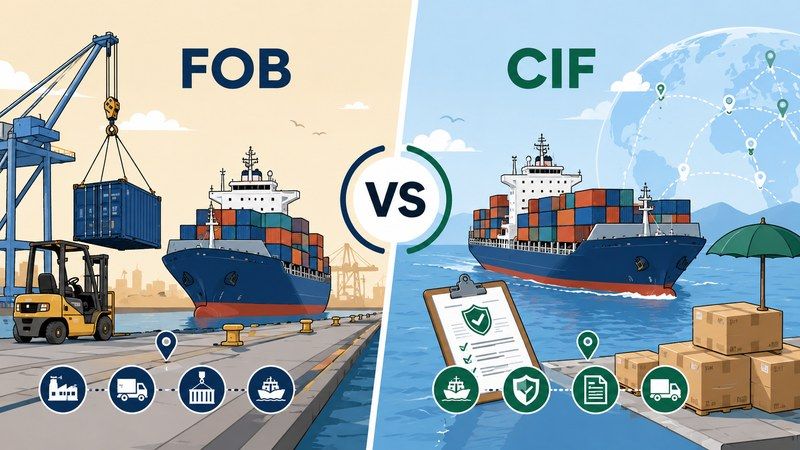
Risk transfers at the same point under both terms. Cost and documents work completely differently. Here is what should actually drive the decision.
Start with what they share
Under both FOB and CIF, risk passes to the buyer when goods are placed on board the vessel at the port of shipment. That part is identical.
So if something happens during the voyage, the loss belongs to the buyer under either term. CIF does not mean the seller is responsible all the way to the destination. This is the most common misunderstanding in practice.
The difference is in cost and documents
CriterionFOBCIFRisk transferOn board at port of shipmentOn board at port of shipmentCost transferOn board at port of shipmentNamed port of destinationCarriage contractBuyerSellerInsurance obligationNoneSeller (minimum 110%)Named placePort of shipmentPort of destinationB/L freight notationFreight CollectFreight PrepaidInsurance documentNot requiredRequired
The pricing mistake almost everyone makes
A FOB unit price and a CIF unit price cannot be compared directly. The CIF price already includes freight to the destination port and the insurance premium.
How to compare properly
FOB price + estimated freight + estimated insurance = a figure comparable to the CIF price
Without this calculation, FOB can look cheaper on paper while the total landed cost ends up higher once freight is paid separately. The reverse happens too: a CIF price that looks expensive may be genuinely competitive if the seller has secured favorable freight terms.
Free resource
CIF and FOB Practical Guide (PDF)
Includes this FOB and CIF comparison plus a full table of all eleven Incoterms, a breakdown of seller and buyer obligations under each term, and a pre-presentation checklist for letter of credit documents with the applicable UCP 600 articles cited.
Download free → https://guild.tflowx.com/ko/post/96
When FOB is the better choice
The buyer has freight negotiating power. If the buyer has their own logistics network or forwarder contracts that beat what the seller can secure, arranging carriage directly under FOB makes sense.
The buyer wants to control schedule and carrier. When vessel selection needs to align with inventory planning or production schedules, FOB gives the buyer that control.
The seller wants to avoid freight rate exposure. If rates rise between contract signing and shipment, the seller absorbs the difference under CIF. FOB removes that risk.
When CIF is the better choice
The buyer lacks carriage arrangement capability. Without a forwarder network in the import country or with limited trade experience, leaving it to the seller is safer.
The seller has favorable freight terms. A volume-based contract with a domestic forwarder means selling on CIF with freight included can produce a genuinely competitive price.
The seller wants document consistency in a letter of credit transaction. Under CIF the seller prepares the insurance document too. Aligning the bill of lading, invoice, and insurance document from one side lowers the chance of discrepancies.
Before you decide
Both terms apply only to sea and inland waterway transport. For air freight, use FCA or CIP.
Containerized cargo deserves a second look. Where goods are handed to a carrier at a terminal, using FOB or CIF leaves the seller bearing risk from terminal receipt until the container is loaded on board, a phase they no longer control. The ICC recommends FCA and CIP in these cases.
Comments 0