600m Glacier Breaks Off Entirely... Massive Nepal Floods After 1200m Fall
[Edaily Reporter Shin Su-jeong] Initial analysis from scientists suggests that the massive flood that struck the border region between Nepal and Tibet, China, claiming at least 160 lives, was likely triggered by a large-scale glacier collapse in the high-altitude region.
The analysis indicates that a glacier mass approximately 600m wide broke off from a mountain and fell about 1200m into a valley, turning shattered ice and water into a massive torrent that swept through downstream villages.
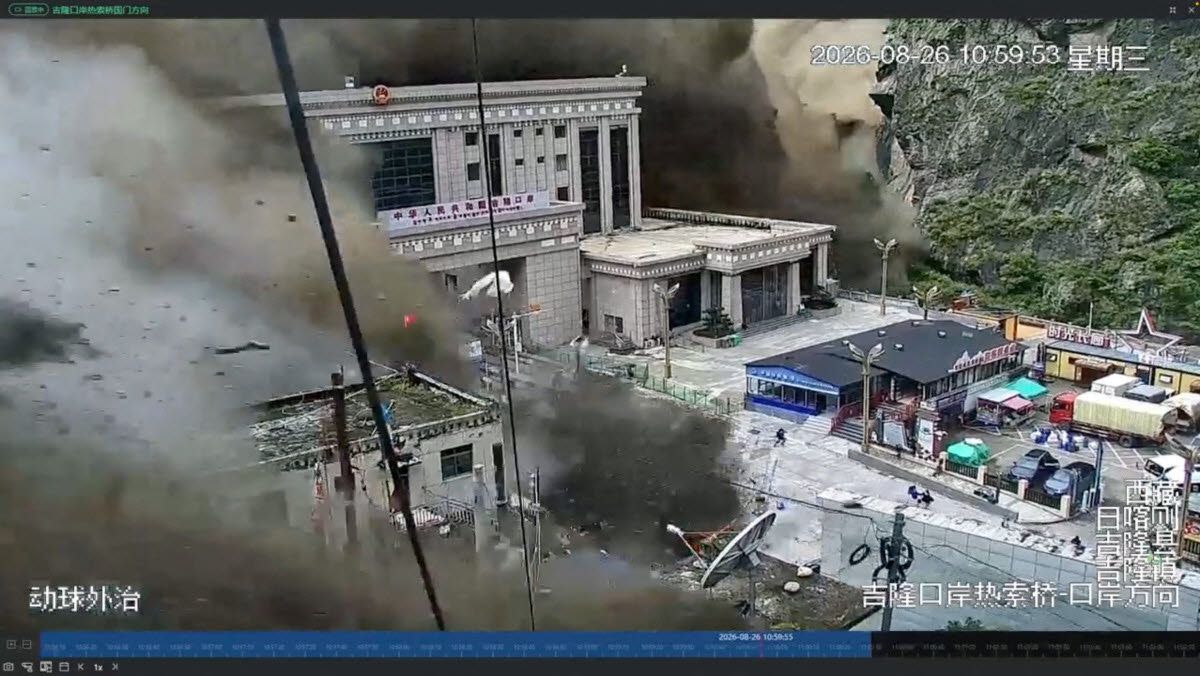
CCTV footage captured people fleeing as a massive wave of mud and water swept through buildings in the Nepal-China border valley of Gyirong, Tibet, China, on August 26, 2026. This screen capture is taken from a video posted on social media. (Photo=Reuters)
According to the New York Times (NYT) on the 26th (local time), geologists and glaciologists determined that the flood was highly likely to have originated from an "ice avalanche" after analyzing satellite imagery and seismic data.
Daniel Suger, a geologist at the University of Calgary in Canada, stated after analyzing satellite images, "It appears that the glacier in this area broke off cleanly," adding, "The glacier fell vertically for more than 1km, crashing all the way to the valley floor."
According to Professor Suger's analysis, an ice mass approximately 2000 feet (about 610m) wide broke away from the glacier on the 26th.
The glacier collapsed at an altitude of about 17,000 feet (about 5200m) and fell approximately 4000 feet (about 1200m).
As the massive glacier mass fell from the high mountain all at once, a tremendous amount of potential energy was released.
Scientists analyze that during the fall, the ice shattered and mixed with water, transforming into a rapidly moving torrent.
Simon Cook, a glaciologist at the University of Dundee in the UK, explained that "massive ice masses stored in high mountains possess enormous potential energy," and that the impact generated when the glacier falls causes the ice to shatter into dangerous torrents.
Regarding the valley floor where the glacier fell, Professor Suger said, "It looks like a bomb exploded," adding, "It is filled with debris from the shattered glacier."
The glacier collapse point was analyzed to be approximately 64km north of Kathmandu, the capital of Nepal.
The ice and water moved northwest along the valley, flowing toward the Bhote Koshi River in the Nepal-China Tibet border region.
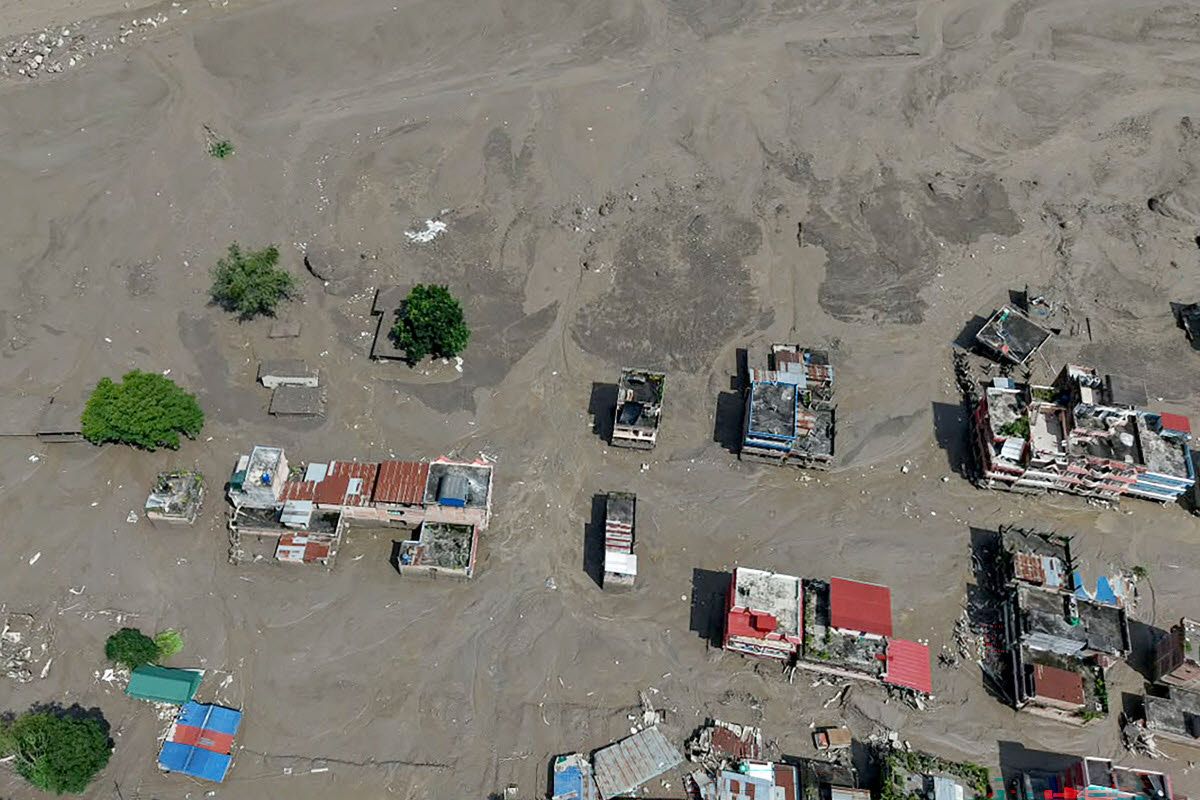
On August 26, 2026, after a sudden flood occurred in Trishuli Bazar, Nuwakot region, Nepal, houses are partially submerged in muddy water along the riverbank. (Photo=AFP)
Smart Investment Life! Subscribe to Naver ChannelDiscover new series! Check it out now.The torrent swept through the border area and caused damage deep into Nepal.
Video verified by the NYT showed a massive mud torrent and debris hitting buildings and parking facilities while residents were evacuating in Gyirong, at the China-Nepal border.
In just a few seconds, buildings collapsed and at least 12 vehicles were buried in mud.
The mud and water flowed at least 45 miles (about 72km) downstream along the Trishuli River, destroying buildings and bridges and flooding surrounding areas.
Satellite imagery also confirmed flood damage in an area approximately 25 miles (about 40km) southwest of Gyirong.
This incident has resulted in at least 160 deaths and hundreds of missing persons along the Nepal-Tibet border.
The death toll is expected to rise.
The impact generated during the glacier collapse was also captured by seismographs.
Local seismic data showed a signal of a massive mass suddenly moving down the mountain around 8:40 AM, followed by a "flow signal" indicating a flood.
The U.S. Geological Survey (USGS) initially recorded this signal as a magnitude 4.4 earthquake.
After further analysis, it was determined to be seismic waves created by the landslide itself rather than an earthquake.
The impact of the landslide generated a signal equivalent to a magnitude 5.2.
Christine Cook, a geomorphologist at the University of Grenoble Alpes in France, said, "A very large signal appears when the event begins, but it does not look like an earthquake," adding, "Based on the local situation and satellite imagery, the current initial assessment is that it is most likely that rock and ice collapsed together and then moved downstream, turning into a torrent."
Scientists are also looking into the possibility that rising temperatures due to climate change influenced the glacier collapse.
Satellite images taken up until the day before the accident showed evidence of snow disappearing rapidly.
The explanation is that as the glacier melts due to rising temperatures, it may have contributed to the collapse.
The Himalayas are one of the regions where temperatures are rising faster than the global average.
As glaciers melt, the risk of landslides or avalanches releasing massive amounts of water all at once and hitting downstream areas is increasing.
In 2021, a large-scale flood occurred in northern Uttarakhand, India, due to a Himalayan glacier collapse, killing over 100 people.
Scientists analyzed that this disaster in the Nepal-Tibet border region shows similar patterns to that incident.
However, researchers emphasized that it is still too early to conclude that the glacier collapse is the sole cause of this flood.
Due to clouds, satellite imagery immediately after the accident is insufficient, and complete meteorological data has not yet been secured.
In particular, the fact that the volume of water observed in this flood is unusually high compared to previous glacier collapse accidents is a subject for further analysis.
Professor Suger said, "The amount of water shown in the video is surprisingly large," adding, "It is more than an order of magnitude larger than similar glacier disasters that have occurred recently."
He added, "There is a strong possibility that there was another cause."
600m Glacier Breaks Off Entirely... Massive Nepal Floods After 1200m Fall
Edaily
Initial analysis from scientists suggests that the massive flood that struck the border region between Nepal and Tibet, China, claiming at least 160 lives, was likely triggered by a large-scale glacier collapse in the high-altitude region. A glacier mass approximately 600m wide broke off from a mountain and fell about 1200m into a valley, shattering...
Comments 0