Proforma Invoice (PI) vs Commercial Invoice (CI): Why a Letter of Credit (LC) Bank Only Accepts One
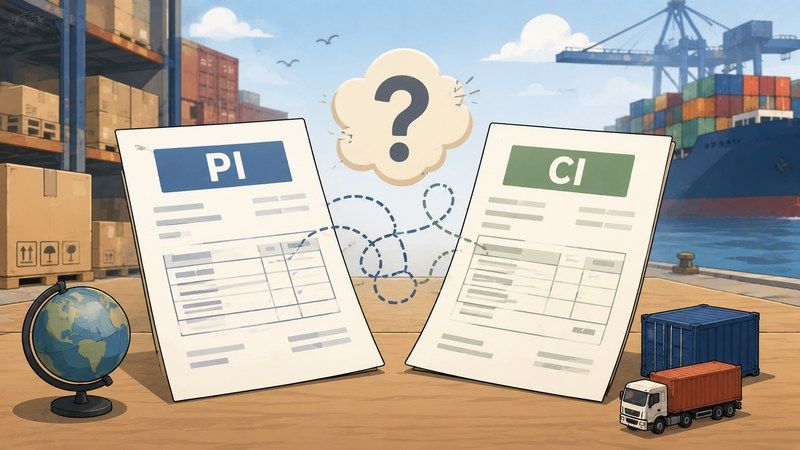
Both documents have the word "invoice" in the name. Both list the same buyer, the same goods, and often nearly identical numbers. That similarity is exactly why new exporters mix them up, and it is exactly why a letter of credit (LC) bank treats them as two completely different things. A proforma invoice (PI) can open a deal. Only a commercial invoice (CI) can close one under an LC.
Same Word "Invoice," Two Completely Different Documents
A proforma invoice looks almost identical to a commercial invoice at a glance, which is exactly the problem. Both show the seller's and buyer's names, an itemized list of goods, unit prices, a total, and payment terms. But one is a quote dressed up as an invoice, issued before the deal is finalized, and the other is the final, binding record of a transaction that has actually shipped or is ready to ship. Confusing the two is not just a labeling mistake. It can mean sending the wrong document to a bank at the wrong stage of the deal.
What a Proforma Invoice (PI) Actually Is (and Isn't)
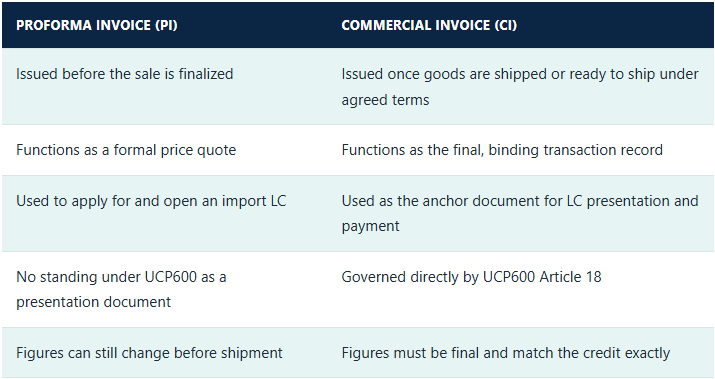
A proforma invoice is issued before the sale is final, typically to give the buyer a formal price quote they can act on. In a letter of credit context, its main job is enabling the buyer to apply to open the LC in the first place: banks and, in many countries, customs or foreign exchange authorities want to see the deal terms in writing before an import LC is issued. What a PI is not is proof that goods have shipped, and it is not a document a bank will accept as part of the document presentation used to trigger payment. It carries no standing under UCP600 (Uniform Customs and Practice for Documentary Credits, the global rulebook banks use to examine LC documents) as a presentation document, because it does not represent a completed transaction.
What Makes a Commercial Invoice (CI) the Only One That Counts Under an LC
The commercial invoice is issued once the transaction is real: goods have been produced, shipped, or are contractually committed to ship under the agreed terms. This is the document UCP600 Article 18 actually governs, the one that must appear to be issued by the beneficiary, made out to the applicant, in the credit's currency, with a goods description that corresponds to the credit's own wording. It is the anchor document every other presented document gets checked against. A PI never carries that weight, no matter how detailed or professional it looks.
One document counts at presentation
Under UCP600, only the commercial invoice functions as a presentation document at the payment stage. A proforma invoice has a legitimate role earlier in the process, at LC application and opening, but it has no standing in the set of documents a bank examines to decide whether to pay.
Where the Confusion Costs Real Time: LC Opening vs LC Presentation
The most common real-world mistake is not confusing what each document looks like. It is confusing when each one belongs in the process. A PI belongs at the start, when the buyer is applying to their bank to open the LC, and its numbers are often provisional: prices and quantities that get refined before shipment. A CI belongs at the end, when documents are presented for payment, and by then its numbers must be final and must match the credit exactly. Exporters who carry PI-stage figures forward into the CI without re-verifying them against the actual shipment, and against the credit's own wording, are the ones who end up with a commercial invoice that quietly disagrees with the deal it is supposed to close out.
A Quick Side-by-Side
How to Avoid Mixing Them Up
The safest habit is to treat the PI and the CI as two separate documents with two separate jobs, never as one document with an updated date. When the deal moves from quote to shipment, the commercial invoice should be built fresh against the credit's own wording, not by copying the PI and changing a few line items. That single habit prevents the most common version of this mix-up: a CI that still carries provisional PI numbers into a presentation where only final, credit-matching numbers are accepted.
T flow L/C Checker is built around exactly this handoff. As part of T flow's full-stack trade operations and finance infrastructure, it treats the credit's own wording as the source of truth for the commercial invoice, verifying beneficiary name, applicant name, currency, and goods description before presentation, so a PI-stage number never quietly survives into a CI that has to match the credit exactly.
Make sure your CI matches the credit, not the quote
See how T flow L/C Checker verifies your commercial invoice against the credit's own wording before you present.
Comments 0