How to Calculate CBM, and Why Your Container Never Fills Up

Ocean freight is not billed by volume or by weight. It is billed by whichever is larger. Here is how CBM works, what a container actually holds versus what the spec sheet says, and the three mistakes that blow up a quote.
CBM is just a cubic meter
CBM stands for cubic meter. Convert the three dimensions to meters and multiply them. That is the whole formula.
CBM = length (m) × width (m) × height (m)
A carton measuring 60cm × 40cm × 50cm:
0.6 × 0.4 × 0.5 = 0.12 CBM
One hundred of them is 12 CBM.
That part is grade-school arithmetic. What follows is where exporters lose money.
You pay on volume or weight, whichever is higher
For ocean LCL pricing, carriers and forwarders bill in revenue tons (R/T). The rule is simple.
The revenue ton rule
1 CBM is treated as equal to 1,000 kg. Compare your shipment's CBM figure against its weight in tonnes, and you are charged on whichever number is bigger.
Two examples:
Apparel, 10 CBM, 1.2 tonnes → volume wins. You pay for 10 R/T
Tiles, 3 CBM, 6 tonnes → weight wins. You pay for 6 R/T
Light bulky cargo pays on volume, dense compact cargo pays on weight. From the carrier's side this is obvious: a vessel runs out of space and runs out of deadweight independently, so they charge on whichever limit your cargo hits first.
Air freight uses a different formula. Volumetric weight for air is length × width × height in centimeters, divided by 6,000, which gives a figure in kilograms. That is compared against actual weight and the higher one is charged. Do not carry the ocean formula over to air.
Three mistakes that break the quote
1. Forgetting the pallet
The most common error by a wide margin. People measure the cartons and leave out what they are sitting on. A wooden pallet typically adds 14 to 15cm of height, and its footprint is usually larger than the carton stack above it. If you are shipping palletized, measure the loaded pallet, not the cargo.
On a ten-pallet shipment, pallet height alone can shift the total by more than 1 CBM. That lands directly on the invoice.
2. Measuring before packing
The figure that matters is the outer dimension of the finished export packaging, measured physically. Cushioning, double-wall corrugate, moisture barriers and stretch wrap all add up. Design drawings almost always understate it.
3. Assuming small means cheap
LCL rates usually apply CBM to two decimal places, and most forwarders have a minimum charge, commonly 1 R/T. A 0.4 CBM shipment is frequently billed as a full revenue ton. The smaller the consignment, the worse your effective rate per CBM.
What a container actually holds
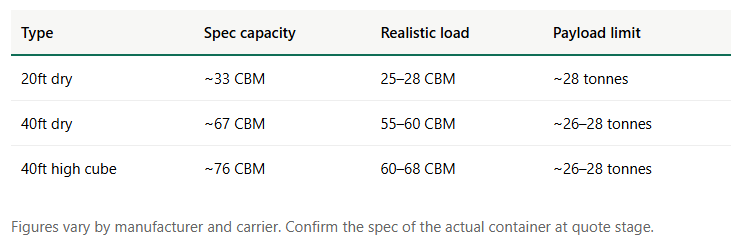
Spec-sheet capacity is the raw internal volume. Nobody ever loads that much.
Why the gap exists
Pallets do not tessellate. Internal width is about 2.35m. Two standard pallets side by side rarely use all of it, and the leftover strip is dead space you still pay for
You cannot stack to the ceiling. Crush risk and handling clearance both demand headroom
The door end stays clear. Door aperture height is lower than internal height, and cargo must not fall out when the doors open
In practice, plan on 80 to 85 percent of spec capacity as usable volume.
For dense cargo, two 20ft beats one 40ft
Look at the table again and something stands out. A 40ft holds roughly twice the volume of a 20ft, but its payload limit is about the same.
The container's own tare weight eats into the allowance, and road axle-weight regulations cap it further. So stone, metal, tiles, machinery and similar dense goods hit the weight ceiling long before they fill a 40ft.
Rule of thumb: if your cargo reaches its weight limit before its volume limit, price two 20ft units. The freight may cost more, but less than being turned away at the terminal for overweight and having to restuff.
When you need a special container
Reefer: refrigerated. The cooling unit takes space, so internal volume is smaller than a dry box of the same external size
Open top: removable roof, for tall cargo that has to be craned in from above
Flat rack: no side walls, for out-of-gauge width or heavy-lift pieces
Tank: liquids and chemicals
Special equipment is scarce and expensive. If you need it, start booking much earlier than you would for a dry box.
Where LCL stops making sense
One of the practical reasons to calculate CBM carefully is this decision. As a general guide, from around 15 CBM it is worth pricing a 20ft FCL alongside your LCL quote. Depending on lane and season, LCL crosses over and becomes the more expensive option.
LCL carries per-shipment accessorials on top of the CBM rate, and consolidation adds transit days. Comparing base freight alone gives you the wrong answer. Get both as all-in totals and compare those.
Key takeaways
CBM is length × width × height in meters. Nothing more.
Ocean LCL bills on CBM or tonnes, whichever is greater.
Air uses centimeters divided by 6,000. Different formula, do not mix them.
Measure the loaded pallet, after packing, physically.
Plan on 80 to 85 percent of spec capacity.
Dense cargo: price two 20ft before assuming a 40ft is cheaper.
These numbers do not stop at the freight invoice
The volumes and weights you calculate here get copied into the packing list, the commercial invoice and the bill of lading. If those three disagree, it becomes a discrepancy under a letter of credit (LC) and a customs clearance problem under collection or T/T terms. T flow L/C Checker catches mismatches across the document set before you present it.
Comments 0