What Is an HS Code and How Do You Find the Right One?

One number decides your buyer's duty rate, your FTA eligibility and whether the goods need a permit. Here is how HS codes are structured, how to classify a product step by step, and the mistakes exporters make most often.
An HS code is a product's international ID number
The Harmonized System (HS) is a product classification system maintained by the World Customs Organization (WCO). More than 200 countries and economies use it. The point is that the same product carries the same number at every customs border.
That one number controls more than people expect:
Duty rate: what percentage the importer pays
FTA eligibility: rules of origin are written per HS code
Import requirements: whether certification, inspection or a license applies
Trade statistics: every country's import and export data is counted by it
The structure: the first six digits are global
An HS code narrows from left to right. Coffee is a clean example.
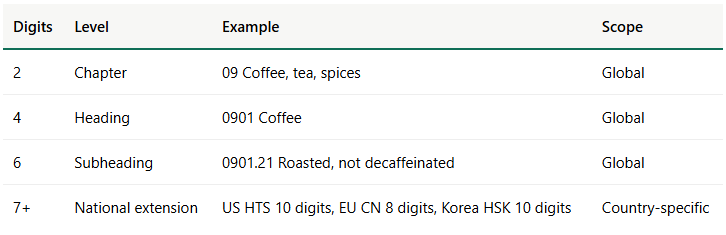
The practical consequence: everything after the sixth digit differs by country. A 10-digit code from your own tariff schedule will not match the 10-digit code your buyer's customs uses. The only part guaranteed to travel across borders is the first six digits.
The importing country makes the final call
You can write an HS code on your invoice, but the classification that counts is the one the importing country's customs decides. Even with the same six-digit system, interpretation varies. It is not unusual for one customs authority to treat a product as a part while another treats it as a finished article.
So align with your buyer before you ship. Ask which code their customs broker intends to declare, and confirm the first six digits match your own classification. If they differ, resolve it before the goods leave.
How to classify a product, step by step
Break the product down. What is it made of (material), what does it do (function), and what is it for (use)? Classification turns on those three questions.
Narrow to a chapter first. Plastic articles sit in chapter 39, machinery in 84, electrical equipment in 85.
Follow the General Rules of Interpretation. The HS has six General Rules for the Interpretation (GRI). The first says classification is determined by the terms of the headings and the section and chapter notes. Picking the heading whose name sounds closest is not how it works.
Check an official database. In the US, the USITC's HTS search. In the EU, the TARIC database. Most customs authorities publish their own tariff schedule online.
When in doubt, get an advance ruling. US CBP issues binding rulings, the EU issues Binding Tariff Information decisions, and many other customs authorities offer equivalents. For high-value or repeat shipments, it is worth the wait.
Five classification mistakes exporters make
Copying a code from a search result: a code on a blog or marketplace listing has no source and no version date
Confusing parts with finished goods: the same component classifies differently shipped alone versus assembled into a machine
Sets: goods sold together as a set are classified by the item that gives the set its essential character. Change the set and the code may change
Mixed materials: you have to determine which material gives the product its essential character
Using the buyer's code unchecked: a buyer may prefer the code with the lowest duty. Responsibility for misclassification does not stay only with them
When the code differs across your documents
The HS code appears on the commercial invoice, the certificate of origin and the export declaration. If it reads differently across them, the problems compound.
The most expensive version: if the HS code on an FTA certificate of origin does not match the code declared at import, customs can refuse the preferential duty rate. The buyer pays the full duty, and that difference usually comes back to the exporter as a claim.
Under a letter of credit (LC), the goods description sometimes includes an HS code. In that case an invoice that shows a different code can be treated as a discrepancy.
Key takeaways
An HS code sets duty, FTA eligibility and import requirements in one number.
Six digits are global. Everything after that is national.
Import customs decides. Agree the first six digits with your buyer before shipping.
Classify by material, function and use, following the General Rules of Interpretation.
When unsure, get an advance ruling.
Keep the code identical on the invoice, certificate of origin and declaration.
Comments 0