Certificate of Origin: What It Proves and When It Comes Back to Bite A certificate of origin is not finished when it is issued. The real test comes years later, when the importing country's customs as

A certificate of origin is not finished when it is issued. The real test comes years later, when the importing country's customs asks you to prove it. Here is the difference between preferential and non-preferential certificates, how origin is actually determined, and where the verification risk sits.
There are two kinds of certificate
A certificate of origin (CO) states where goods were made. But depending on its purpose, it is one of two very different documents.
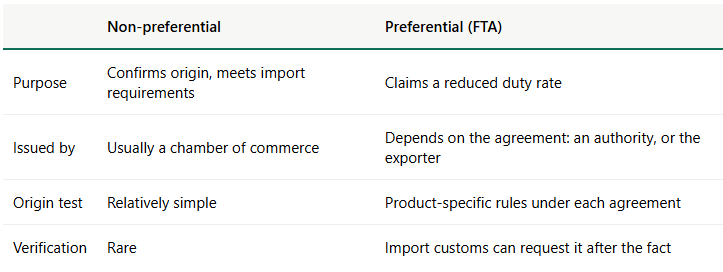
A non-preferential certificate says "this was made here." A preferential certificate says that and then adds "so reduce the duty." Because money depends on it, the rules are stricter and the scrutiny comes later.
Who issues it depends on the agreement
Authority-issued: customs or a chamber of commerce reviews the claim and issues the certificate. Many Asian agreements work this way
Self-certified: the exporter (and sometimes the producer or importer) determines origin and makes the statement. USMCA works this way, and the EU uses registered or approved exporter schemes for many of its agreements
Self-certification looks easier, but there is a catch. With no authority reviewing your claim, the responsibility for getting origin right sits entirely with you. If it is wrong, there is no one else to point to.
How origin is decided: HS codes come back
"Made in this country" is less obvious than it sounds. If you import raw materials and process them locally, where is the finished product from? Each agreement sets the test product by product. There are four main types.
1. Wholly obtained
Produced entirely in one country, such as crops grown or minerals extracted there.
2. Change in tariff classification (tariff shift)
If the imported materials and the finished product fall under different HS codes, enough transformation is deemed to have happened. Whether the change must be at the 2, 4 or 6-digit level is set per product.
3. Regional value content
A minimum share of the product's value must be created inside the FTA region.
4. Specific process
A defined manufacturing step must take place in the country.
The tariff shift rule shows why HS classification matters so much. Get the codes of your inputs or your finished product wrong and the origin determination is wrong with them. Classification is where origin starts.
The real risk is verification
A preferential certificate is not used once at the border and forgotten. Import customs can ask for proof of origin well after the goods have cleared. That is why exporters must keep the supporting records for the period the agreement requires, commonly around five years.
If verification fails
Customs claws back the duty it waived, often with penalties, from the importer. The importer passes the bill to you, and the relationship takes the hit too. A shipment from years ago turns into an invoice today.
The most common failure point is supplier evidence. To prove your product's origin you also have to prove where its materials came from. If you never collected origin declarations from your suppliers, getting them years later is often impossible.
Five checks before you issue
Which agreement to use: some country pairs are covered by more than one FTA. Compare the duty savings and the origin rules and pick the better one.
The product-specific rule: confirm whether your HS code is subject to a tariff shift, a value content test, or something else.
Supplier evidence: get origin declarations from suppliers before you ship.
Consistency: the description, quantity and HS code on the certificate must match the commercial invoice.
Letter of credit terms: if a letter of credit (LC) calls for a certificate of origin, check whether it names an issuing body. Presenting a self-made statement when the LC requires a chamber of commerce certificate is a discrepancy.
Key takeaways
Non-preferential certificates confirm origin. Preferential certificates claim a duty reduction.
Issuance differs by agreement. Self-certification puts the full responsibility on you.
Origin starts from HS classification. The tariff shift rule is the clearest example.
The real exposure is verification years later. Keep the records.
Collect supplier origin declarations before you ship, not after.
Comments 0