Packing List Discrepancies: The Overlooked Reason Banks Reject Documents Under a letter of credit (LC)
Trade documentation, letter of credit (LC) compliance
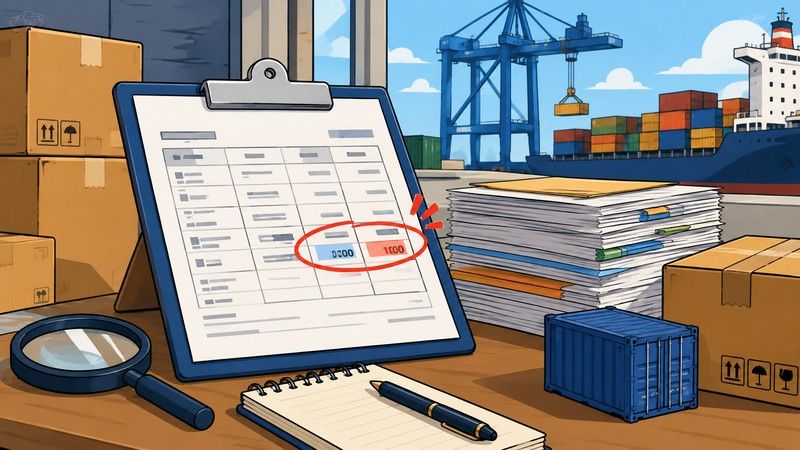
Most exporters spend their document review time on the commercial invoice and the bill of lading. The packing list gets treated as an afterthought, a copy of numbers that already exist somewhere else. That assumption is exactly why packing list discrepancies show up so often in bank rejections under a letter of credit (LC): nobody double checks the one document whose entire job is to match everything else.
What counts as a packing list discrepancy under an LC
UCP600 Article 14 sets the general standard for how banks examine documents. Under this article, the data in each stipulated document does not need to be identical, word for word, to the data in every other document. But it must not conflict with that data, with the letter of credit itself, or with UCP600. This is the rule that governs how a packing list gets judged.
A packing list discrepancy happens when the quantity, weight, packaging count, or shipping marks on the packing list conflict with the same information on the commercial invoice, the bill of lading, or the terms of the LC. Because the packing list exists specifically to be cross-checked against the rest of the document set, even a small inconsistency here becomes a payment-blocking discrepancy rather than a minor typo.
The most common packing list errors banks flag
Carton or package count mismatch: the number of cartons on the packing list does not match the number stated on the bill of lading.
Weight inconsistencies: net weight or gross weight differs between the packing list and the bill of lading, often from unit conversion or rounding at different stages of preparation.
Shipping marks and numbers that do not match: marks on the packing list are written differently from the marks shown on the bill of lading.
Goods description conflicts: the description of goods on the packing list contradicts the description on the commercial invoice, which Article 18 requires to correspond with the description in the LC.
Quantity that ignores the LC's shipment conditions: the packing list reflects a quantity that does not respect the partial shipment or quantity tolerance terms stated in the LC.
Missing signature or issuer detail when the LC specifically requires the packing list to carry one.
Published ICC Opinions and DOCDEX decisions on quantity and partial shipment issues, documented extensively in real trade dispute casebooks, keep returning to this same pattern: a number that does not match across two documents is treated as a discrepancy regardless of how obviously it was a typo.
Why these discrepancies keep happening
Packing lists are rarely written by the same person, at the same time, from the same source data as the commercial invoice. Warehouse or logistics staff often prepare the packing list from the physical shipment, while sales or finance staff prepare the invoice from the sales contract. When a shipment changes at the last minute, one document gets updated and the other does not. Add in unit differences (kg versus lb, net versus gross) and rounding, and a document that looks fine in isolation stops matching the rest of the set.
The five business day rule. Under UCP600 Article 16, once a bank receives the documents, it has five banking days after the day of presentation to decide whether they comply and to notify the beneficiary of any discrepancy. Miss the notice, and the bank can lose the right to refuse payment on that basis. But this cuts both ways for exporters: banks have five full days, and every incentive, to find exactly this kind of mismatch. A packing list discrepancy caught during that five day window is a payment already at risk.
How T flow L/C Checker prevents these errors before you submit
T flow is not a narrow letter of credit (LC) verification tool. It is full-stack trade operations and financial infrastructure built for exporters who cannot afford a five-day guessing game after documents are already in the bank's hands. T flow L/C Checker cross-checks the packing list against the invoice, the bill of lading, and the LC terms before submission, flagging carton count mismatches, weight inconsistencies, and mismatched shipping marks while there is still time to fix them.
Key takeaways
A packing list discrepancy is almost never about the packing list in isolation. It is about a conflict between the packing list and everything else in the document set.
Article 14 does not require identical data across documents, but any real conflict in quantity, weight, or marks will be flagged.
Article 16 gives the bank five business days to find the exact issues a pre-submission check could catch first.
Do not let a five-day review window decide the fate of your payment. See how T flow L/C Checker catches packing list discrepancies before the bank does.
#packing list discrepancy #letter of credit LC #LC document examination #UCP600 Article 16 #UCP600 Article 14 #export documentation #trade finance compliance #ISBP821 #bank document rejection #T flow L/C Checker
Comments 0